




 Our Leadership Team
 Find An Advisor
 Our Platform
 Advisory
 Alternatives
 Insurance
 Specialized Services
 Individual Investors
 Retirees
 Business Owners
 Family Offices & Institutions
 Doctors
 Tenants
 Accountants
 RIA / Advisor Firms
News
Middle East Tensions & Market Impact
Posted on April 6, 2026

What Investors Should Know Now
Geopolitical tensions in the Middle East have escalated in recent weeks, with direct military actions involving the United States, Israel, and Iran. The situation has expanded beyond a localized conflict, drawing in additional regional actors and increasing the risk of broader instability.
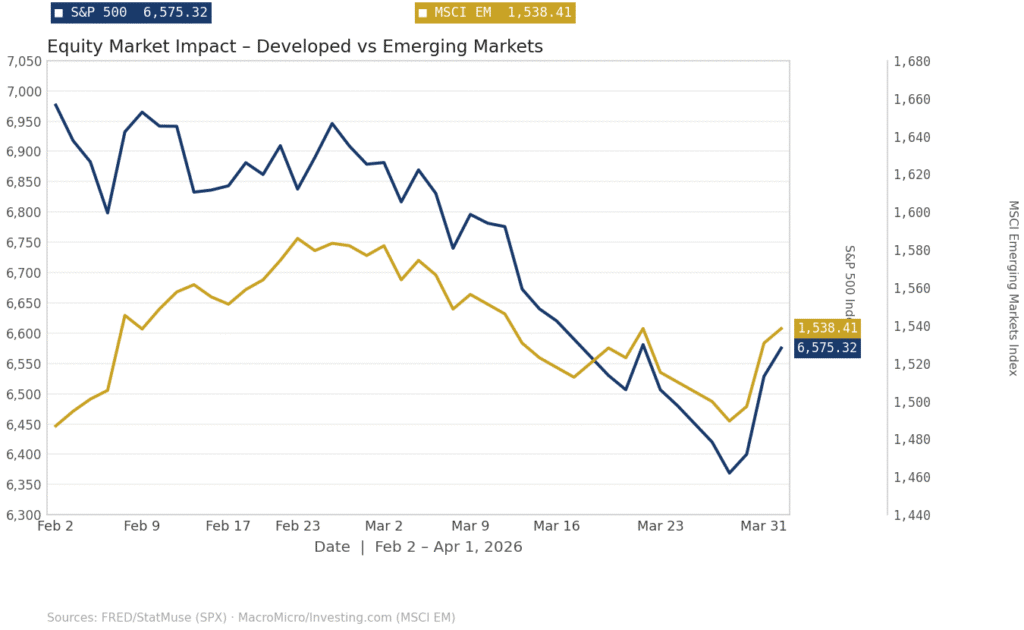
One of the most immediate market reactions has been in energy. Oil prices have risen as investors assess the possibility of supply disruptions, particularly around the Strait of Hormuz, a critical global shipping route for energy. At the same time, we’ve seen a familiar “risk-off” response: short-term equity volatility and a stronger U.S. dollar as investors seek stability.
While headlines may feel unprecedented, the market’s reaction so far has been relatively orderly and consistent with past geopolitical events.
How this Impacts the U.S. and Global Economies
While the ripple effects are real from an economic perspective, history shows us these patterns are fairly well understood.
- Energy & Inflation Pressure: Higher oil prices can quickly filter into gasoline, transportation, and goods costs.[i] This creates upward pressure on inflation, which could complicate the Federal Reserve’s path on interest rates.[ii]
- Global Trade & Supply Chains: Disruptions to shipping routes (especially near key energy corridors) can increase freight costs, delay shipments, and ripple through global supply chains.[iii]
- Market Sentiment & Volatility: Markets don’t like uncertainty. As new developments unfold, we can expect continued short-term swings across equities, interest rates, and commodities.[iv]
That said, it’s important to distinguish between temporary shocks and lasting economic change. At this stage, markets are primarily repricing risk, not signaling a structural breakdown in the global economy.
What Should Investors Be Watching?
When headlines intensify, it’s easy to feel like everything matters. In reality, a few key factors tend to drive the true investment impact:
- Sustained oil price increases (not just short-term spikes)
- Whether inflation remains elevated as a result
- Central bank responses, particularly from the Federal Reserve[v]
- Any prolonged disruption to global trade routes
These are the variables that can influence longer-term economic conditions, not the day-to-day headlines.
What Investors Shouldn’t Worry About
This is where perspective becomes incredibly valuable. History shows that while geopolitical events can create short-term volatility, they have rarely altered the long-term trajectory of markets.
Even during periods of war and global conflict, equity markets have continued to grow over time, driven by fundamentals like earnings, innovation, and economic expansion.
It’s also important to note that market drawdowns tied to geopolitical shocks have often been relatively short-lived, with recovery happening faster than many expect.
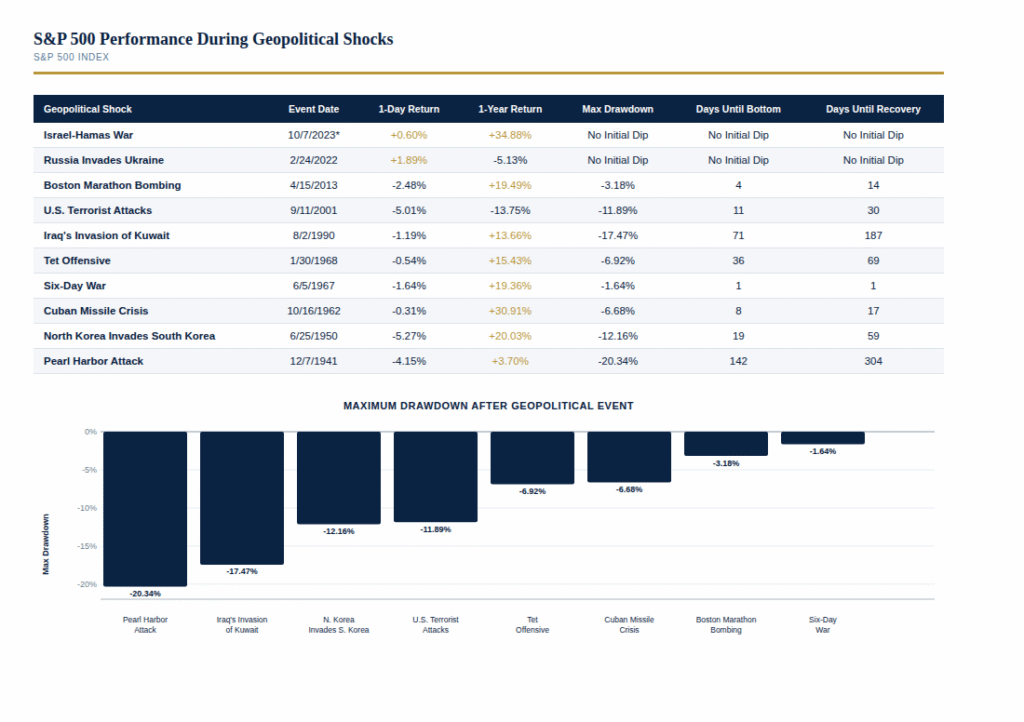
S&P 500 1-day return, 1-year return, maximum drawdown, and days to recovery following major geopolitical shocks. Source: FactSet, First Trust.
In other words: Not every headline requires a knee-jerk reaction. Reacting too quickly can often do more harm than good.
Your Plan was Built for Moments Like This
If there’s one message we want to reinforce, it’s this: your financial plan already accounts for uncertainty.
We build portfolios with the expectation that events like this will happen because they always do. That means:
- Diversification to help manage risk across environments
- Strategic asset allocation aligned with your goals
- A long-term framework that isn’t dependent on any single event
Volatility isn’t a flaw in the system; it’s part of it.
The Biggest Risk Isn’t the Market: It’s Over-Reaction
Periods like this can tempt investors to do something, like moving completely to cash, changing strategy, or trying to outmaneuver the market.
But historically, the bigger risk has been emotional decision-making, not the event itself.
Markets are forward-looking. They adjust quickly, process new information, and often stabilize well before the news cycle does.
Staying disciplined, especially when it feels hardest, has consistently been one of the most effective strategies for long-term investors.
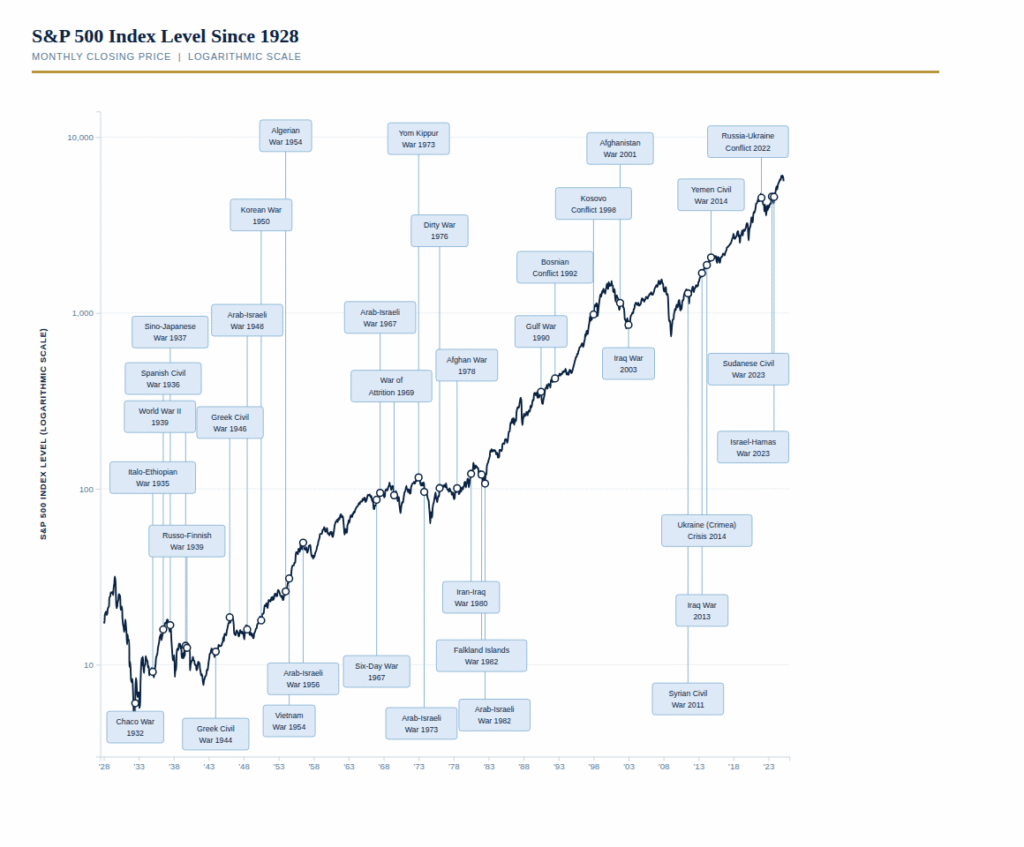
S&P 500 Index Level Since 1928 (monthly closing price, logarithmic scale) with major global conflicts annotated. Source: FactSet, First Trust.
Our Perspective
Our team is actively monitoring:
- Energy markets and inflation trends
- Federal Reserve policy expectations
- Credit markets and broader economic signals
- Any signs of prolonged geopolitical escalation
At this stage, financial markets remain functional, resilient, and aligned with historical patterns during geopolitical events.
However, if conditions shift in a way that meaningfully impacts portfolios, we will communicate and adjust thoughtfully, not reactively.
Final Thoughts
What’s happening in the Middle East is serious, and it’s understandable to feel uneasy given the headlines. But perspective matters.
Taken together, the historical record offers an important reminder for long-term investors: while geopolitical events can create short-term volatility, historically they have not derailed the broader growth trajectory of equity markets.
One of the greatest risks during periods of uncertainty isn’t the event itself. Instead, it’s reacting to short-term headlines instead of staying focused on the long-term fundamentals that truly drive markets. Equity prices are shaped by expectations for future earnings growth, innovation, and economic expansion, forces that have proven resilient across decades of global conflict and change.
Over the past century, markets have navigated wars, crises, and uncertainty while continuing to compound wealth over time. For disciplined investors, maintaining a long-term perspective through periods of volatility has consistently been one of the most effective ways to capture that growth.
At Larson Financial, our investment approach is grounded in evidence, not emotion. We remain committed to keeping your portfolio aligned with your long-term goals, and to helping you stay focused on what matters most, no matter what’s happening in the headlines.
If you have questions or simply want to talk through what this means for you, we’re always here to help.
[i] https://www.reuters.com/business/energy/oil-prices-drop-hopes-us-pullback-iran-war-2026-04-02/
[ii] https://www.foxbusiness.com/economy/iran-war-could-push-inflation-higher-year-goldman-sachs-says
[iii] https://www.csis.org/analysis/irans-real-war-against-global-economy
[iv] https://www.reuters.com/business/us-stock-futures-climb-iran-war-de-escalation-optimism-lifts-sentiment-2026-04-01/
[v] https://www.cnbc.com/2026/03/27/markets-see-the-feds-next-move-as-a-potential-hike-as-oil-prices-inflation-fears-rise.html


